For anyone moving to the Netherlands to work or to study
You'll be asked for your BSN before you have one.
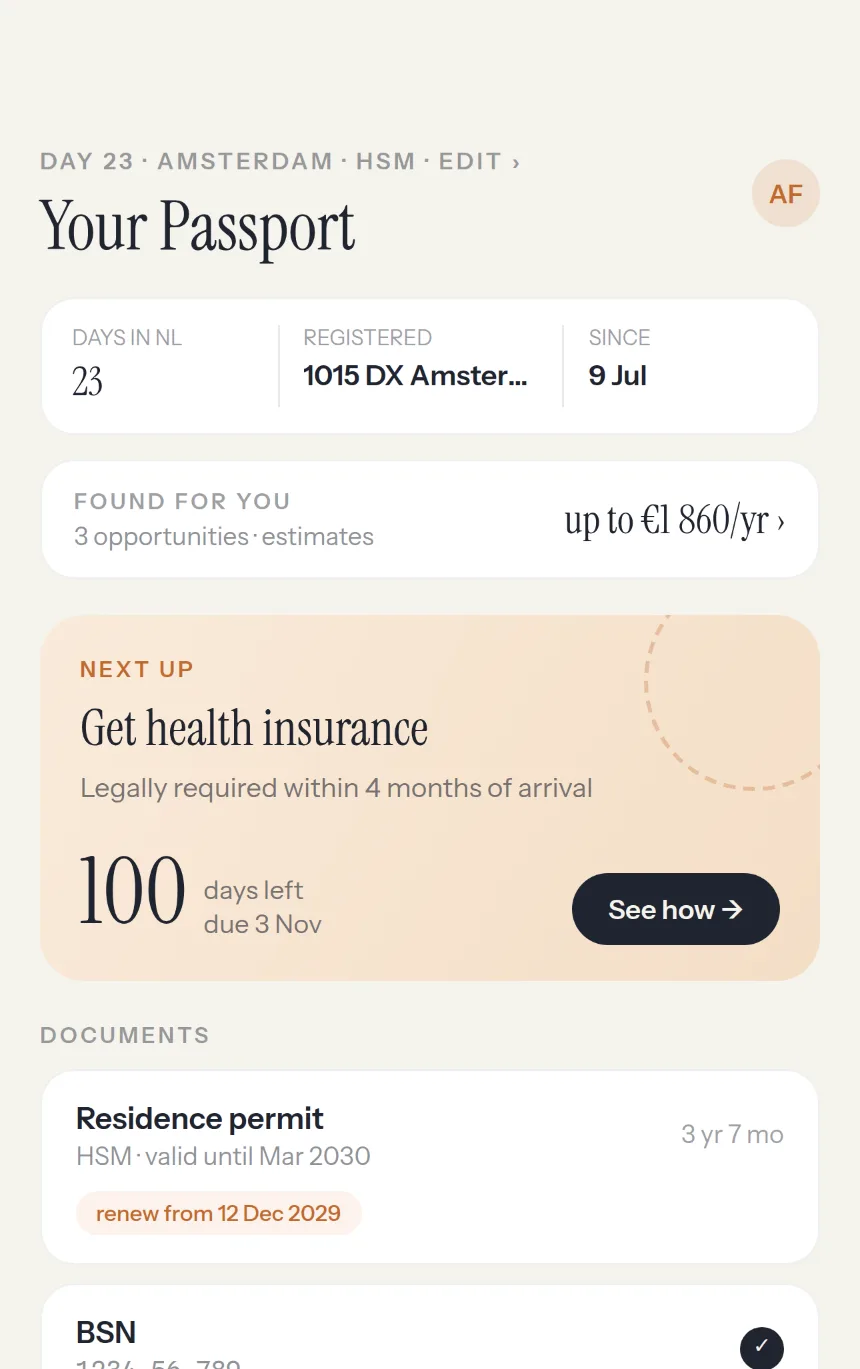
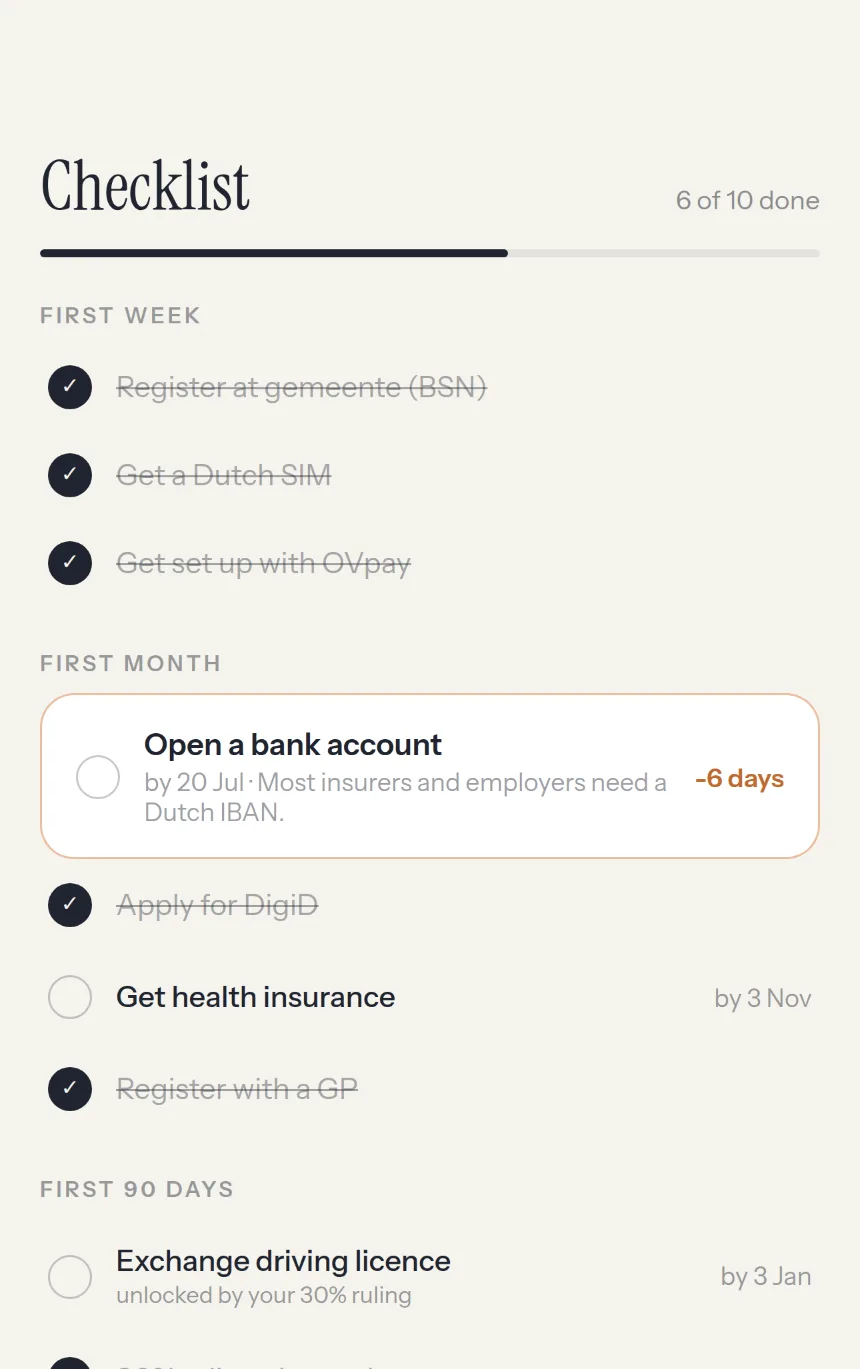
That is what the first months here are like. settlme asks where you are from, which permit you have and when you arrived. Then it shows you only the rules that are yours, and the dates they fall on.
- Free, nothing to buy
- No account needed
- iPhone today, Android next
Start here
Two answers decide which rules are yours
Where your passport is from, and which permit you have. Everything else follows from those two. The app asks you once, at the start.
From the EU, the EEA or Switzerland
You do not need a residence permit. You do not need a work permit. You can work as many hours as you like, for any employer. You still have to register with your gemeente, get a BSN and take Dutch health insurance, the same as everyone else.
From anywhere else
You have a permit, and the permit sets your rules. It sets how long you can stay, how many hours you can work, and whether an employer has to apply for a work permit for you. You do the same registration and insurance steps as everyone else.
The EEA is the EU plus Iceland, Liechtenstein and Norway. Switzerland has its own agreement with the same effect. If you are British and lived here before 2021, the Brexit withdrawal agreement gives you similar rights.
Three ways people arrive
You are here to study.
Everyone who studies here. The limits on working are for students from outside the EU.
There is a limit on how much you can work while you study. Whether you need Dutch health insurance depends on whether you have a job. Student housing has a waiting list, and it is worth joining early.
- How many hours you may work in term, and when the limit lifts
- Whether your employer has to apply for a work permit for you
- Whether you need Dutch health insurance while you only study
You are here for a job.
Everyone who works here. Permit renewals are for people from outside the EU.
A residence permit has to be renewed, and the date comes sooner than most people expect. The 30% ruling runs for a fixed number of years, counted from your first day of work.
- When your residence permit has to be renewed
- How many years of the 30% ruling you have left
- What changes when you move to a new employer
You have just graduated here.
Graduates from outside the EU. If you are from the EU, you can simply stay and work.
The orientation year gives you twelve months to find work. During it, no employer needs a permit to hire you. You have to apply in time, and it cannot be extended.
- How long after graduating you can still apply for it
- What it allows that a student permit does not
- The date it ends, counted from the day it starts
What it looks like
What it does
The things that cost people money
Health insurance is backdated
You have four months to choose a Dutch health insurer. You pay from your first day here rather than from the day you sign. So waiting does not save you money. It builds a bill.
You have five days. The appointment takes weeks.
If you stay longer than four months, you must register with your gemeente within five days of arriving. In Amsterdam the first free appointment is often six weeks away. Both of these are true at the same time. The app tells you what to do about it.
Your passport decides half of it
Which rules are yours depends on where you are from and which permit you have. The app asks you once, then hides everything that is not yours.
If you are here to study
Students have their own set of rules
Most guides about moving to the Netherlands assume you arrived with a job. As a student, some rules work differently for you. Some do not apply to you at all. These are the ones people miss.
There is a limit on the hours you can work
This one is for students from outside the EU. You may work a set number of hours a week during term, and full time in the summer months. Your employer has to apply for a work permit for you before your first day. An unpaid placement that is part of your course does not need one. A paid job or placement does. Students from the EU have no limit and need no work permit.
Health insurance depends on whether you work
This one is for everyone. While you only study, insurance from your home country is often enough. As soon as you take any paid work, even a few hours a week, you have to take Dutch basic insurance. You then have four months to arrange it, counted from the day that duty started.
Student housing has a waiting list
The student housing organisations give out rooms mostly by how long you have been on their list. So join on the day your university accepts you. The app puts this task before your arrival date.
There is money you may be able to claim
DUO gives student finance and a cheap travel product to students who work enough hours each month. Most of this is for students from the EU. The app checks whether you qualify, so you do not find out in your final year.
If you live in Belgium or Germany, it works differently
Many students at the border universities keep living across the border. You only register with a gemeente if you really live in the Netherlands. If you travel in each day, you get a BSN another way, and the office you need may be in a different town.
Your student years count if you stay
Years on a student permit count in full towards permanent residence. They count for less towards Dutch citizenship. The app works out both dates from your own history.
Ask the community
You are not the first person to do this
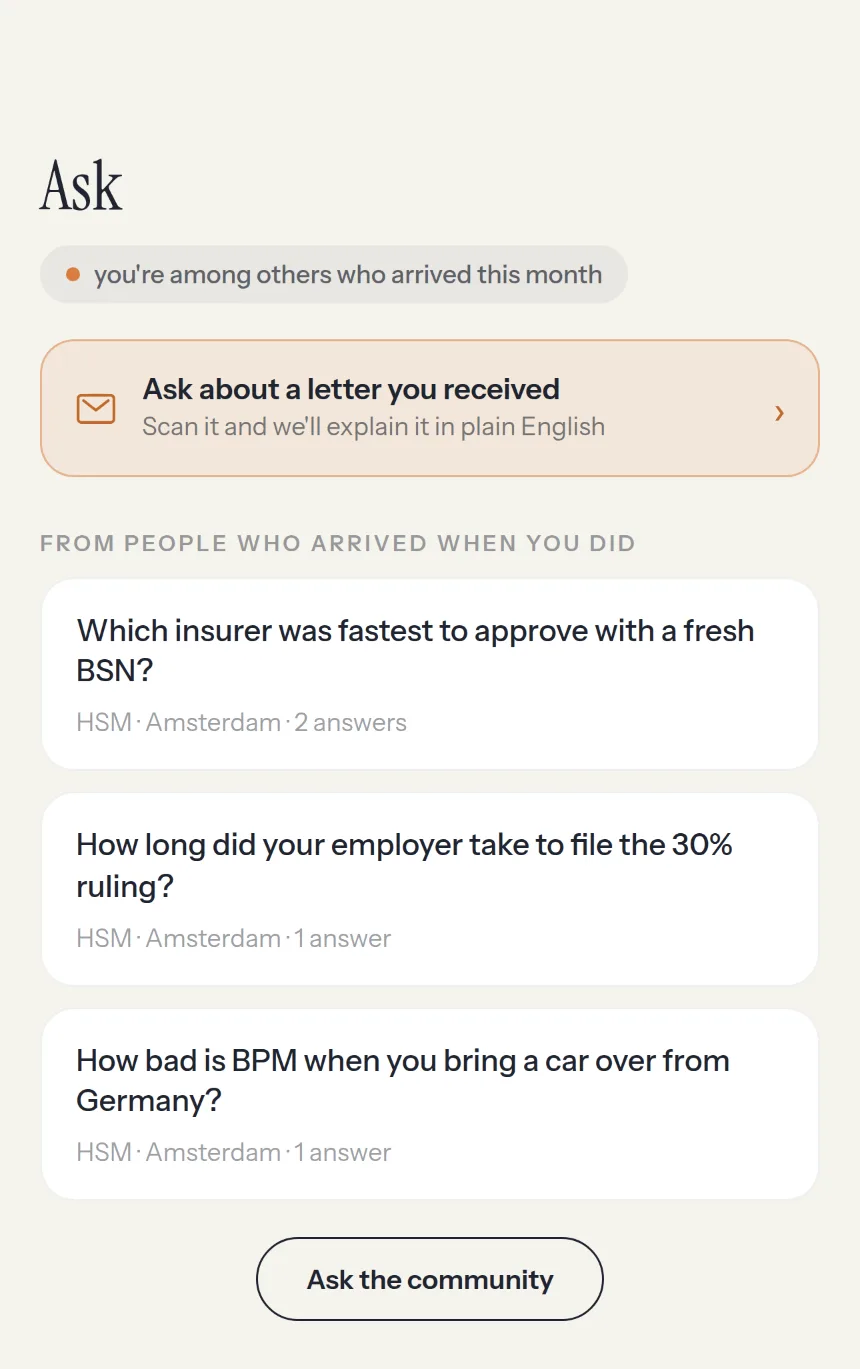
Your question goes to people who arrived around the same time as you, and to people in your city. The answer usually comes from someone who solved the same thing a few weeks ago. The queue at your gemeente. The landlord who wants three payslips you do not have yet. The letter you cannot read. Someone there has had it. Posts show initials only.
Pricing and privacy
Free, and it does not ask who you are
What free covers
All of it. The full checklist, every deadline it finds for you, three letter scans a month, and a household of up to five people. There are two limits because every scan costs us money to run. Keeping them is how the app stays free.
What it knows about you
There is no account to create. The app recognises your device rather than you. Your BSN, your IBAN, your policy numbers and your address never reach our servers. They stay in your phone's own keychain. All we hold is the dates the checklist needs.
Read up
The five things people look up at two in the morning
One page for each. What the deadline is, what starts it, and what it costs you to be late. Each page says who it is for, so you can tell in one line whether it is about you.
Arriving in the Netherlands to study
How many hours you may work, whether you need Dutch health insurance, and how the housing lists work. Plus DUO student finance, and the orientation year after you graduate.
Read the guideGetting your BSN
Your BSN comes from registering with your gemeente. What to bring, the five-day rule and the appointment waiting time, what you can do while you wait, and what the number is for.
Read the guideHealth insurance in your first months
Basic health insurance in the Netherlands is compulsory, you get four months to choose, and the policy is backdated to your first day. Who is exempt, what waiting costs you, and what happens if you ignore it.
Read the guideThe orientation year, or zoekjaar
Twelve months of unrestricted access to the Dutch labour market after you graduate. Who qualifies, how long after graduating you can still claim it, and what has to be in place before it ends.
Read the guideThe 30% ruling
The 30% ruling lets an employer pay part of your salary in the Netherlands without tax. Who can claim it, the four-month window that decides whether it is backdated, and what changing jobs does to it.
Read the guide
Questions people ask first
- Who is settlme for?
- Anyone moving to the Netherlands, and anyone who arrived recently. It works whether you are from the EU or from outside it. It works whether you are here for a job, to study, or on an orientation year. It covers the paperwork everybody meets: your gemeente registration, your BSN, health insurance, DigiD, a Dutch bank account, your first tax return, and permit renewal dates.
- I am from the EU. Do any of these rules apply to me?
- Some of them. You do not need a residence permit or a work permit, and nobody limits your hours. You still register with your gemeente, get a BSN, take Dutch health insurance and file a first tax return. The app asks where you are from at the start, and then hides the parts that are not yours.
- I am a student. Is any of this for me?
- Yes. Students get their own version of the app. It covers the hours you may work and the months when the limit lifts. It covers whether your employer has to apply for a work permit, and whether you need Dutch health insurance while you only study. It also covers the housing lists, DUO student finance, and the orientation year once you graduate.
- Does it cover the orientation year?
- Yes. The orientation year is for graduates from outside the EU. It runs for twelve months from the day it is given, and it cannot be extended. So the app holds the date it ends, and what has to be ready before then. It also holds the deadline for applying after you graduate, which is the one people miss.
- Is this an official government service?
- No. settlme is independent and is not a government service. It has no connection to the IND, the Belastingdienst, DUO, the RDW, the CBR, the SVB, Logius or any gemeente. It cannot send anything to any of them for you. It reads the published rules and works out which ones are yours. Where a decision is binding, the authority's own answer is the one that counts.
- What does it cost?
- Nothing. There is nothing to buy. Two things have a limit: three letter scans a month, and five people in a household. That is because every scan costs us real money to run. Everything else has no limit. There are no adverts, and we sell no data.
- When is it out?
- It is out now for iPhone, in the App Store. Android is next. Join the waiting list and we will email you once it is ready for you.
- What happens to my data?
- Your BSN, your IBAN, your policy numbers and your address stay in your phone's keychain. They are never sent to us. All we hold is the dates your deadlines are counted from. When you scan a letter, we remove personal details such as your BSN and your postcode before anything is stored. Nothing is sold or shared with advertisers.
Get your list before the first letter arrives
It is on the App Store today. If you use Android, join the waiting list and we will send one email when it is ready. There is no newsletter.